Tool Overload
Part of Collaboration software costs
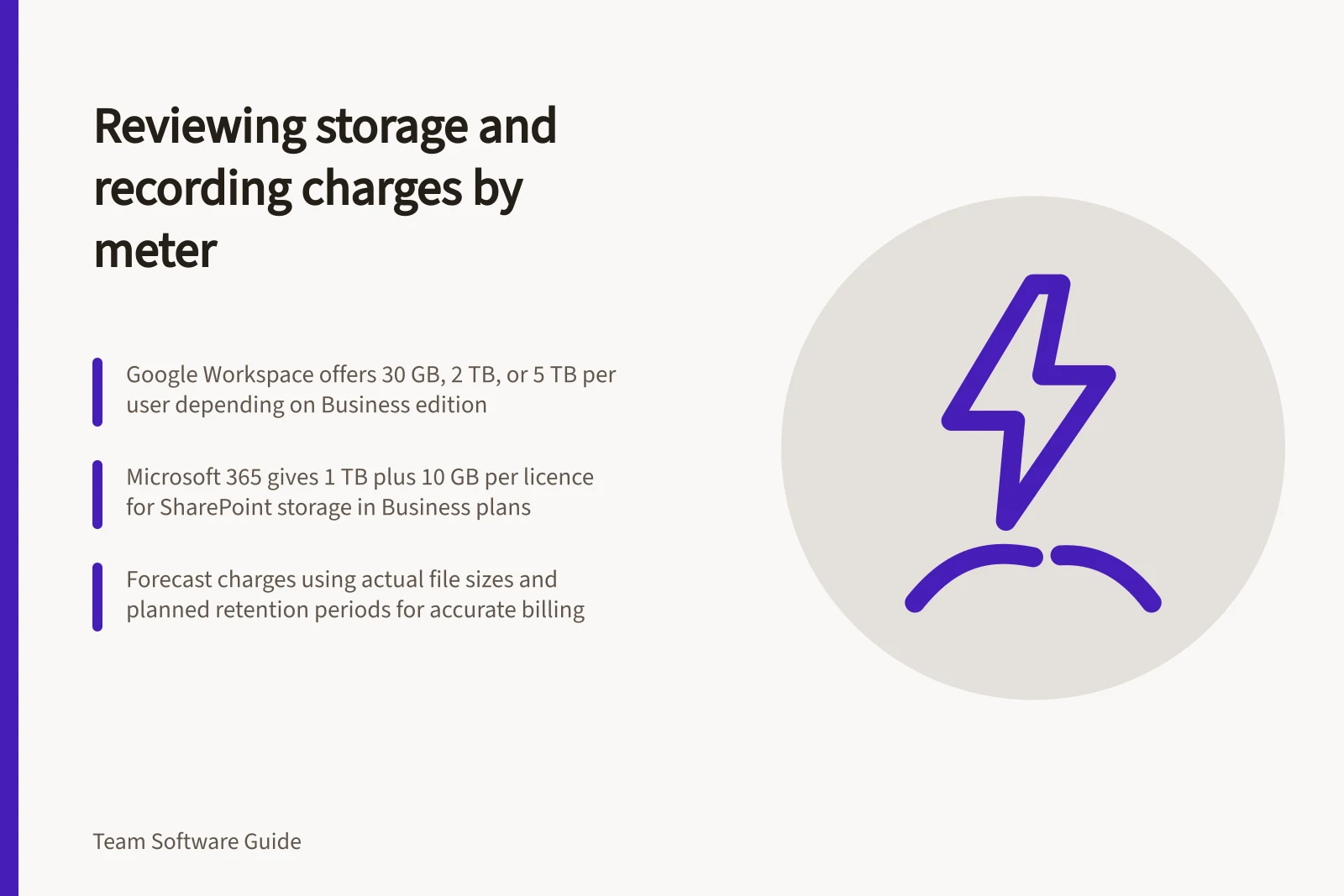
Reviewing storage and recording charges by meter
Separate pooled storage, shared-site capacity and cloud recordings, then forecast usage and confirm the applicable add-on or overage price.
Storage capacity and billable charges are separate checks. Review each provider’s meter, allowance and charging rule, then forecast normal and peak use; a combined GB total can conceal which limit or bill will move first.
Keep plan fees, storage add-ons and overage charges separate. Record the currency and tax treatment of any quoted cost so you can budget in Australian dollars.
Map each meter
Ask the administrator for the current plan, usage and allowance. Separate Google Workspace’s organisation-wide storage pool, Microsoft SharePoint site storage and OneDrive accounts, and Zoom cloud recordings. Record who owns each store, recent growth and the point at which action would be needed.
| Service | Allowance to inspect | Budget question |
|---|---|---|
| Google Workspace | Organisation-wide pool built from per-user edition allowances | Will the proposed edition mix and any eligible extra storage cover expected use? |
| Microsoft 365 | SharePoint storage used across sites and total subscription storage | Is growth in personal files, shared sites or both? |
| Zoom cloud recording | Included meeting-recording capacity by plan and licensed user | Could peak stored recordings require additional capacity? |
Confirm which service and storage allowance each recording uses before assigning it to a forecast.
Read the plan limits
Google Workspace lists 30 GB of pooled storage per user on Business Starter, 2 TB on Business Standard and 5 TB on Business Plus. These allowances contribute to an organisation-wide pool; they do not describe unused space in each account.
Google’s listed prices from 15 January 2027 are £5.90 per user/month for Starter, £11.80 for Standard and £18.40 for Plus. The pricing page says prices exclude tax and shows promotional prices from 15 October 2026 to 15 January 2027: £4.13 for Starter, £8.26 for Standard and £14.72 for Plus. The displayed currency is GBP, not AUD.
Google Workspace administrators can move to a subscription with higher storage limits or buy additional storage on the current subscription. For an Australian budget, confirm the applicable price, currency and tax treatment before using either option.
Microsoft’s SharePoint limits give Microsoft 365 Business and Enterprise tenants 1 TB plus 10 GB per purchased licence. Extra SharePoint storage is available in 1 GB tenant increments, and an unlimited amount can be purchased.
The SharePoint total excludes the OneDrive created for each licensed user. Standalone OneDrive plans contribute 0.50 GB per licence to tenant limits. SharePoint storage is measured in binary GB, where 1 GB equals 2^30 bytes.
The SharePoint admin centre’s Active sites page shows storage used across all sites and total storage for the subscription. Storage reports can include version history and other storage-related data, so reported use can exceed the combined size of current files.
Zoom’s meeting cloud-recording table lists 10 GB per licensed user for Pro, Pro Plus and Business, and 15 GB per licensed user for Business Plus. Enterprise and Enterprise Plus list unlimited meeting-recording storage. Zoom Phone storage is a separate allowance.
Zoom’s pay-as-you-go model charges usage not covered by the plan at the agreed plan rate. A monthly or yearly prepaid commitment covers designated usage; usage beyond the commitment is charged at the plan rate. Cloud-recording storage is calculated from the highest amount used during the billing period, and a commitment can lower overage fees.
Microsoft 365 Storage Limits and Pricing
- SharePoint site storage
- 1 TB + 10 GB per licensed user (Business/Enterprise)
- Extra storage
- Available in 1 GB increments; unlimited options available
- Reporting accuracy
- Version history and metadata may inflate reported usage beyond file size
Forecast the charge
For each meter, estimate current stored amount + expected new material − material approved for removal. Use a normal month and a busy month.
For recordings, estimate how many meetings will be recorded and the typical file sizes, using measured sizes from the organisation rather than a generic gigabytes-per-hour guess. Include the intended storage period in the estimate.
Forecast each bill as the plan fee plus any applicable extra-storage or overage charge. For a per-user monthly plan price, multiply the price by the number of users; for storage add-ons and overages, use the confirmed billing unit and rate.
Ask the supplier or billing administrator for the exact add-on, eligibility, billing unit and overage rule on the proposed plan. Record the quoted currency and tax treatment, and confirm that any material counted as removable may be removed before including its space in the forecast.
The output is one line per meter. List plan, allowance, current use, expected peak, action threshold, remedy, quoted cost, currency and tax treatment.
Forecasting Storage Usage: Key Metrics
- Current stored amount (GB)
- Use actual data from admin dashboards
- Expected new material (GB/month)
- Based on historical trends and team growth
- Material approved for removal (GB)
- Confirm deletion eligibility before forecasting
- Remedy options
- Upgrade plan, buy add-on, or purge old files